The best roof for a tropical climate: what the research says
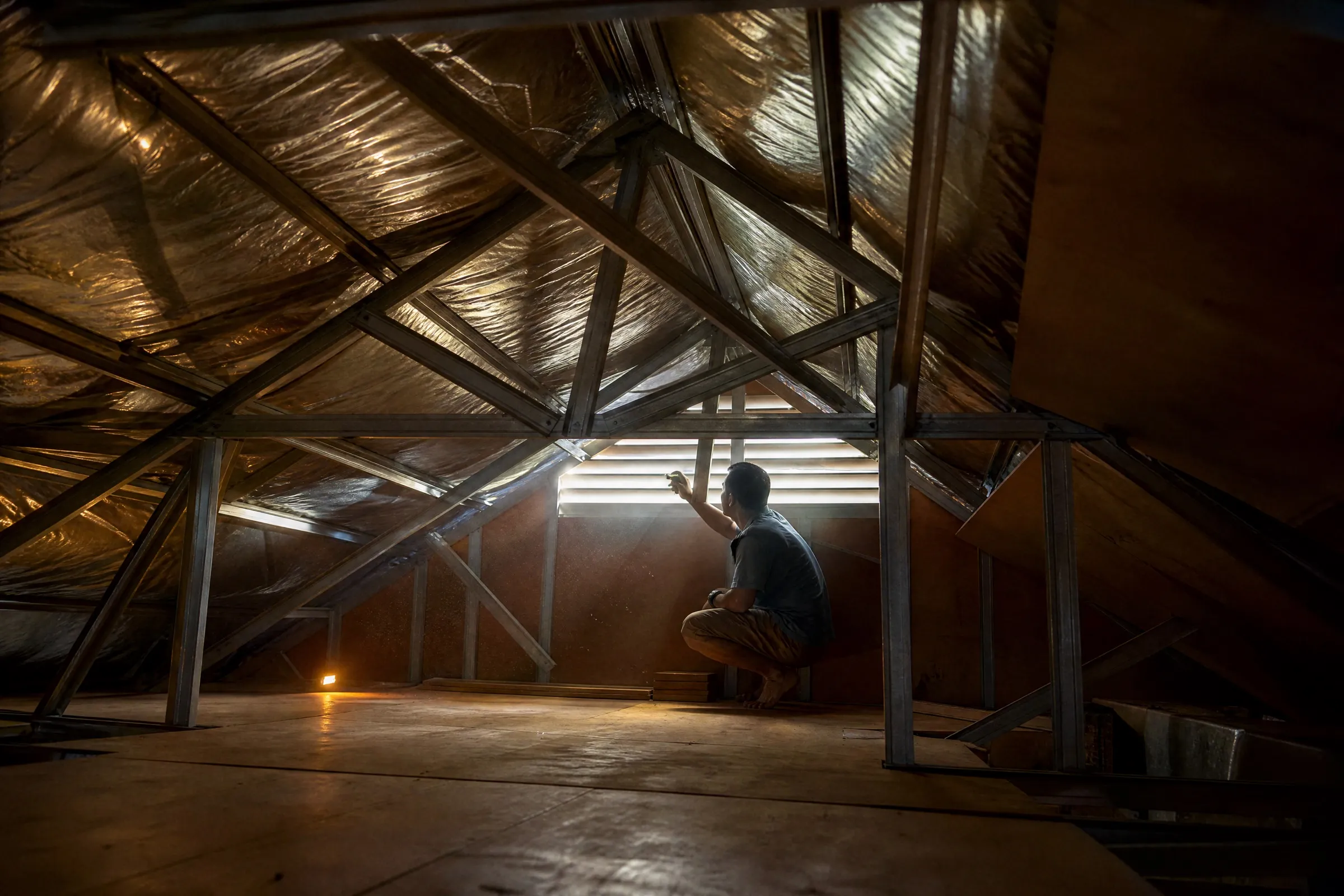
If you have moved to Indonesia from a cooler country, the roof will shape how your house feels more than almost anything else. Here is what measured studies show, rather than what sellers claim.
The roof is where the heat comes in
A review of passive cooling research for tropical houses in Southeast Asia put the roof at about 70% of total heat gain. That makes roof decisions more important than walls or windows for comfort.
What measurably lowers the temperature
| Measure | Result | Where |
|---|---|---|
| Ventilated space under the roof | Indoor air 1.2 °C cooler on average | North Sulawesi, zinc roof |
| Ceiling with aluminium foil | Indoor air 0.5–2 °C cooler than a bare roof | Small-scale test models, Indonesia |
| Lighter roof colour | Maroon zinc roofs ran more than 1 °C hotter than silver or blue | Manado |
| Red tiles changed to white | Peak roof surface up to 16 °C cooler, cooling energy down up to 13% a year | Malaysia, simulation |
The roofing material matters as well. In North Sulawesi, average attic temperatures were 33.7 °C under plain zinc, 33.02 °C under heat-resistant painted zinc, and 31.7 °C under a coconut-leaf roof.
Rain noise
Heavy tropical rain on a thin roof can stop a conversation. In a laboratory rain test following ISO 10140, a single-skin trapezoidal metal roof measured 74 dB; a build-up with glass wool and damping tape brought it to 52 dB. Whatever you choose, ask what sits between the rain and the room.
Where asphalt shingles fit
Asphalt shingles are nailed onto a solid deck of 12 mm plywood or GRC board over the frame, with a waterproof underlayment between. That deck damps rain noise and slows heat moving down, and the shingles can follow complex roof shapes down to walls. They need a minimum pitch of 10–15° depending on brand, and their colour affects heat like any roof. Costs and brands are in asphalt shingles in Indonesia.
Related questions
- Is metal roofing too hot for the tropics?
- Not necessarily. In a Florida test of identical houses, a white metal roof gave the coolest attic of all the roofs tested. Thin, dark metal with no ceiling or insulation is a different story: in North Sulawesi, plain zinc sheeting produced an average attic temperature of 33.7 °C.
- Are asphalt shingles hot?
- The surface absorbs heat, more so in dark colours: in the Florida test, dark grey shingles reflected about 8% of sunlight and white shingles about 24%. Shingles always sit on a plywood or GRC deck, which slows heat moving downward. We have not found a study measuring asphalt shingles in Indonesia, so we do not claim they are the coolest option.
- What matters most for a cool house?
- Across the studies, the most consistent wins are a ventilated space under the roof, a ceiling with a reflective layer, and a lighter roof colour.
Sources
- Al-Obaidi, Ismail & Abdul Rahman (2014), Frontiers of Architectural Research 3(3): 283–297
- Kindangen & Rogi (2020), attic ventilation in zinc-roofed buildings, humid tropics (Atlantis Press)
- Kindangen, Sompie & Rogi (2025), zinc roof colour and temperature, International Journal of Civil Engineering 12(6)
- Kindangen, Rogi & Gosal (2025), Civil Engineering and Architecture 13(2): 965–975
- Muchammad (2006), ceiling with radiant barrier, ROTASI 8(4): 34–40
- Farhan et al. (2021), roof tile colour and cooling load in Malaysia, Sustainability 13(9): 4665
- Florida Solar Energy Center, report FSEC-CR-1220-00
- Wittmann, Heissler & de Oliveira (2022), rain noise on metallic roof tiles, Acústica e Vibrações 37(54)